The Saints are With Us
Chaplaincy Spotlight
- Sunday Masses Schedule
- Sunday: 07:00am & 09:00am
- Holy Hour
- Every Sunday: 6.30pm - 07:30pm
- Know Your Faith
- 2nd & 4th Sunday: 5.00pm
- Weekday Masses Schedule
- Monday - Friday: 6:15am
- Saturday: 07:00am
- Monday: 12:Noon (Students & Staff)
- Monday, Wednesday & Friday: 6:30pm
- Wednesday Adoration
- Every 1st and 2nd wednesday: 6.30pm
- Baptism
- 1st Saturday: 08:00am
- Infant Baptism Preparatory Class
- Every last Sunday of the Month: Immediately after the Second Mass
- Sacrament of Reconciliation
- After Morning Masses: Saturday
- Marriage Class
- Every Sunday: 02:00pm
- General Office Hours
- Monday, Tues, Fri: 09:00am - 04:00pm
- Wed: 09:00am - 01:00pm
- Break-Time: 01:00pm - 02:00pm
- Thursday: Off day
- Chaplain Office Hours
- Tuesdays & Fridays
- Time: 09:00am - 01:00pm
- Father's Off Day - Thursday
- Personal Devotion In Church
- Monday - Saturday: 09:00am - 06:00pm
- Sunday: 12:00noon - 06:00pm
- Catechism / Confrimation Class
- Sunday: 04:00pm
The Saints are With Us
Posted on:June 22nd, 2016
Adapted from More Grace
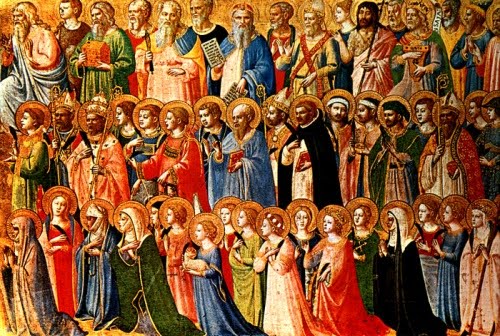
“Why do you pray to the saints? Why are the saints so important in the Catholic Church?” This is another common question that we hear from non-Catholics. The saints seem to be everywhere in the Catholic Church–in our stained-glass windows, our walls, and we even adopt the name of a saint at Confirmation. Like our own parish, many of our parishes are named after saints. Just look around the Archdiocese and you’ll see countless parishes named after saints. We Catholics certainly have a thing for our saints–why?
Every nation has its own national heroes–people who contributed much to the good of the people and who are still honored and remembered for it. In Washington, DC and around the United States, we see statues of Abraham Lincoln, George Washington, Martin Luther King, Jr. and so many others. In London, you’ll see statues of Winston Churchill. The Church, as the New People of God, also has her heroes–and these are the saints.
There are over 10,000 canonized saints of the Catholic Church–people the Church proclaims are in heaven because of their virtuous lives, their example of following Christ, and in many cases, their martyrdom for the faith. Every person in heaven is a saint–but the Church officially recognizes certain people as deserving of the title of “Saint.” It is important to remember that the Church doesn’t make saints, but rather recognizes saints. When Pope Francis canonized Sts. John Paul II and John XXIII last year, he recognized their holy lives and extraordinary witness.

How are the saints such an example to us today? Why are they so helpful to us in our lives?
The saints show us two vital points about the Christian spiritual life.
Firstly, They show us that it is possible to transform one’s life through the Gospel. The Gospel is challenging; it requires a complete transformation of our entire being. Catholicism is sacramental: God works in the world and through our lives, constantly forming us into saints. It is possible for the Christian message to change us–if we allow God’s grace to move in our lives. The saints did exactly this.
Secondly, They show us that it’s possible to transform one’s life according to the Gospel, despite the fact that we are still sinners. A common saying is, “A saint is a sinner who keeps trying.” Or, another one is: “A sinner is someone who thinks he’s a saint. A saint is someone who thinks he’s a sinner.” Even the holiest of saints were sinners and needed Confession and the Eucharist just as we do. They struggled with sins, often for a long time, but they persevered to the end. When they frequently fell, they did not give up–like Jesus carrying His Cross, they kept getting up after falling.
When we fall, we should approach Confession and move on, learning from our mistakes and allowing God’s healing grace to sanctify us. Look at St. Peter–the man who denied Jesus three times!–who repented of his sin and became the great first Pope of the Church.
Have you ever been to a great party on a Saturday night, and want to invite your friends to join? It’s been a long, stressful week, and a nice night out is just what you need. You attend a party with friends, good music and great company. You call or text other friends, inviting them to join: “Johnny! Where are you?! Come join us!” The saints in heaven are enjoying the Beatific Vision- they see God face to face- which is the greatest joy anyone can ever have.
They have reached the fullness of charity, and because love wants to be given away, they naturally desire that the rest of us on earth join them in the heavenly kingdom.
Imagine this: you are walking a rope bridge across a massive, high canyon. The bridge is loose, it sways easily in the wind, and you hesitate to take each step out of fear that it might break. Far below is a wild river that would easily sweep you away. You are nervous, afraid, and unsure if you can even make it across. But on the other side, a group of friends has already made it across. They are enjoying a grand feast and are safe from the danger of the bridge collapsing.
They have already walked the dangerous bridge and are enjoying the reward of it. They are calling to you, waving to you, encouraging you to keep moving forward confidently and steadily, until you too reach the solid ground across the canyon. And when you finally take that last step to safety, they embrace you and welcome you into their celebration. And then you, too, turn around and encourage those behind you to make the long walk across. The circle of sainthood continues- the saints encourage us to become saints, and one day in heaven we can encourage others on earth to become saints.
This is, in a sense, how it is with the saints! They are our friends and want us to join them in the heavenly feast. They have gone before us, they have made it, and they now possess the greatest thing anyone could ever possess- the Beatific Vision, or seeing God face-to-face forever in heaven. Because they possess the greatest gift possible, and because love naturally wants to be given away, they want the rest of us to enjoy the same life in heaven.
If you’ve ever run a marathon, you would understand this analogy. The last few miles of a marathon are painful, exhausting- all you want to do is walk the rest of the way. You see the finish line, and you muster whatever remaining strength your legs contain in order to finish the race. Those runners who finished the race before you are now beyond the finish line- with a medal and food and drinks. They cheer you on, encouraging you to complete the race with a sprint. This, too, is like the saints in heaven- they cheer us on when the race gets tough.
In a previous article, I discussed the power of Mary in interceding for us to God. As the greatest saint and the Queen of heaven and earth, Mary can especially pray on our behalf. Every saint in heaven, too, can pray for us. It’s not that we pray to them, but that we ask them, as our friends and allies, for their prayers and aid. As citizens of heaven, they have a special way of interceding for us. They have finished the race, and because they want us to finish it as well, they are happy to pray for us. They have gone before us in the faith, and their lives are tireless examples of how the Christian life can be lived in different times and cultures.
There’s another point- saints have lived (and still live) in all different nations, cultures, times in history, states of life, and circumstances. Many were poor, and indeed many were rich. Many were slaves and many were free. Kings and queens are saints, as well as the poorest of the poor. Men and women, Jews and Gentiles, black and white are saints. Look at Thomas More- one of the most powerful men in Renaissance England- who gave his life for his faith. The saints prove that Christianity is for everyone, at all times and in all places, in all states of life and for all peoples.
On November 1st every year, we celebrate the Feast of All Saints. On many days throughout the year, we celebrate the feast days of particular saints, remembering their contributions to the Church and their examples to us. But on November 1st, we honor all saints- including the countless saints who are not officially canonized as such by the Church. They are our relatives, our friends, our neighbors, and many others whom we have never met but who are now in heaven. So many saints who lived humble, quiet lives have gone before us- and All Saints Day is especially for them.
Do you have a favorite saint? Is there a saint whom you go to for comfort and help? Sometimes, saints have a way of “showing up” in our lives. God “sends” individual saints to help us here on earth. If you don’t have one, ask God to send you one, and He will do it. Trust me on this one!